

Three Main Hindered Phenolic Antioxidants: What Are the Differences?
Three Main Hindered Phenolic Antioxidants: What Are the Differences?
AO-1010, AO-1076, and AO-3114 — all are primary antioxidants, so why are there so many differences? A formulation expert with over a decade of experience explains their thermal stability, molecular structures, and ideal application scenarios.
By: Yihuo Science & Technology Editorial Team
Have you ever encountered this situation? You add an antioxidant to your formulation, but after just a few months, the material starts to lose its performance. You want to switch to a better grade, but when faced with a series of product codes — 1010, 1076, and 3114 — you are unsure which one to choose.
This is one of the most frequently asked questions among formulation engineers: What exactly are the differences between these three antioxidants? Can one grade simply replace the others?
Today, let's break it down once and for all.
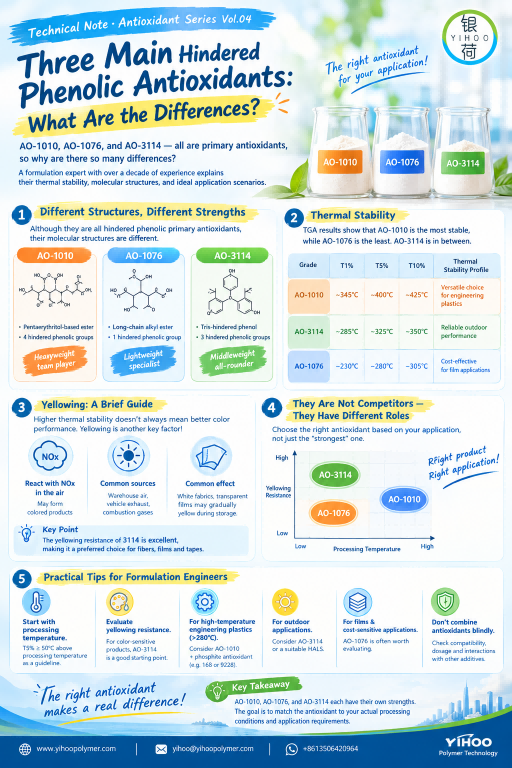
1. First, Understand Their Structures: They Are Not the Same
Although all three are called hindered phenolic primary antioxidants, their molecular structures are fundamentally different. Think of them as three athletes with different physical builds and strengths.
| Parameter | AO-1010 | AO-1076 | AO-3114 |
|---|---|---|---|
| Molecular Structure Type | Pentaerythritol-based ester | Long-chain alkyl ester | Tris-hindered phenol |
| Molecular Weight | ~1,178 (high molecular weight) | ~531 (relatively low molecular weight) | ~784 (medium molecular weight) |
| Functional Groups | 4 hindered phenolic groups | 1 hindered phenolic group | 3 hindered phenolic groups |
| Analogy | Heavyweight team player | Lightweight specialist | Middleweight all-rounder |
| Typical Applications | Engineering plastics, PC, PA, PBT | PE/PP films, woven bags | Outdoor fibers, thin-walled molded parts |
The Difference in One Sentence
-
AO-1010 is the “team player” — four phenolic groups work together to provide antioxidant protection.
-
AO-1076 is the “lone wolf” — one phenolic group delivers antioxidant protection in a relatively compact molecular structure.
-
AO-3114 is the “middleweight contender” — three hindered phenolic groups offer a balance between the other two structural types.
So, which one is the strongest?
There is no absolute winner — only the grade that best fits your application.
2. Comparing Thermal Stability: TGA Curves Don't Lie
When the three antioxidants are tested by TGA at a heating rate of 10°C/min, the results are as follows. These values are based on published literature and general industry experience; they are not measurements for any specific brand.
Approximate TGA results under nitrogen (N₂):
-
AO-1010: ~400°C at 5% weight loss (T5%)
-
AO-3114: ~325°C at 5% weight loss (T5%)
-
AO-1076: ~280°C at 5% weight loss (T5%)
| Grade | T1% | T5% | T10% | Thermal Stability Profile |
|---|---|---|---|---|
| AO-1010 | ~345°C | ~400°C | ~425°C | “Versatile choice for engineering plastics” |
| AO-3114 | ~285°C | ~325°C | ~350°C | “Reliable outdoor performance” |
| AO-1076 | ~230°C | ~280°C | ~305°C | “Cost-effective for film applications” |
What Do These Numbers Tell Us?
AO-1010: The heavyweight champion.
AO-1010 ranks first by a considerable margin. Its T5% is approximately 400°C, meaning that it loses only 5% of its mass at around 400°C under the specified test conditions. This makes it a strong candidate for materials processed at approximately 280–320°C, such as PC, PA, and PBT.
AO-1076: The least thermally stable of the three.
AO-1076 begins to lose weight at lower temperatures, with a T5% of approximately 280°C. This is generally sufficient for PE and PP film processing at around 200–240°C. However, formulations exposed to processing temperatures above 250°C require more careful evaluation.
AO-3114: The middleweight contender.
With a T5% of approximately 325°C, AO-3114 is suitable for many engineering-plastic applications, although its thermal stability is lower than that of AO-1010. Its key advantage is its three hindered phenolic groups, making it a common choice for outdoor fibers and thin-walled molded parts.
Why Is AO-1010 So Thermally Stable?
The key lies in its molecular architecture: its pentaerythritol-based structure, high molecular weight, and four hindered phenolic groups contribute to its performance. It also tends to leave more carbonaceous residue during high-temperature decomposition under certain test conditions.
By comparison, the lighter AO-1076 may leave very little residue at 600°C, depending on the test conditions and grade.
3. Yellowing: A Brief Guide
Many people assume that better thermal stability automatically means better overall performance. However, color-sensitive products have another hidden challenge: yellowing.
Why Does Yellowing Occur?
Hindered phenolic antioxidants can react with nitrogen oxides (NOx) in the surrounding air, potentially forming colored reaction products. These substances may cause yellowing during storage or use.
Potential sources of NOx include warehouse air, vehicle exhaust, and combustion gases.
In the industry, this phenomenon is commonly known as gas fading.
White nylon fabrics, transparent films, and other light-colored materials may gradually develop a yellow tint during storage, sometimes becoming noticeably discolored.
Comparing Yellowing Resistance
| Parameter | AO-1010 | AO-1076 | AO-3114 |
|---|---|---|---|
| Gas-fading / yellowing resistance | Good | Good | Excellent; an industry benchmark |
| Volatility / migration tendency | Low | Relatively high due to its lower molecular weight | Low |
| Resistance to water extraction | Medium | Medium | High |
| Recommended for color-sensitive applications | General-purpose | General-purpose | Preferred for fibers, films, and tapes |
Note: The gas-fading ratings are qualitative assessments based on publicly available supplier TDS information and common industry application experience. They are not measured YI (Yellow Index) values and should not be interpreted as a universal ranking for every formulation.
A Common Formulation Mistake: Assuming Higher Molecular Weight Is Always Better
In some applications, the opposite of what you might expect is true.
For color-sensitive nylon fibers and white films, choosing AO-1010 simply because of its higher molecular weight may not deliver the desired result. AO-3114 can be a more suitable starting point when gas-fading resistance is a priority.
Remember this principle:
Yellowing is not determined by the antioxidant alone. It depends on the interaction between the antioxidant and NOx, as well as the overall formulation and processing conditions.
With the right molecular structure, oxidation protection and yellowing resistance can both be considered in the formulation design.
4. They Are Not Really Competitors — They Have Different Roles
Many people assume that a higher-grade primary antioxidant can simply replace a lower-grade one. In practice, the three products cover different thermal-processing ranges and application requirements.
Combined with the yellowing considerations discussed above, antioxidant selection is essentially a two-dimensional decision: thermal stability × yellowing resistance.
| Application | Processing Temperature | Yellowing Tolerance | Recommended Primary Antioxidant | Why? |
|---|---|---|---|---|
| PE/PP films and conventional extrusion | 200–240°C | Medium | AO-1076 | Cost-effective, good flow properties, and sufficient thermal stability for many standard applications |
| Nylon fibers, white/light-colored films, and tapes | 200–260°C | Very low; yellowing must be minimized | AO-3114 | A common choice for gas-fading-sensitive applications, with low migration tendency and good resistance to water extraction |
| PC/PA/PBT engineering plastics | 280–320°C | Medium; darker colors may be acceptable | AO-1010 | Good thermal stability and relatively low volatility due to its high molecular weight |
| White food packaging and medical devices | 200–260°C | Very low; yellowing must be minimized | AO-3114 / AO-1076 | AO-3114 may be preferred for gas-fading-sensitive applications; AO-1076 may also be used, subject to regulatory and formulation requirements |
| High-temperature nylon, PPS, and PEEK | 320°C+ | Application-dependent | AO-1010 + phosphite co-antioxidant | A synergistic stabilization system may be required; AO-1010 alone may not provide sufficient protection under all processing conditions |
The key is not to choose the strongest antioxidant, but to choose the right one for your application.
Evaluate the processing temperature, yellowing tolerance, and application environment together before making a selection.
5. Practical Tips for Formulation Engineers
Here are six practical guidelines to help you avoid common mistakes when selecting antioxidants.
-
Start with the processing temperature. This is the first constraint when selecting a primary antioxidant. A T5% margin of at least 50°C above the processing temperature is a useful initial screening guideline, but it is not a universal guarantee of performance.
-
Then evaluate yellowing resistance. For color-sensitive nylon fibers and white films, AO-3114 is a useful starting point and is widely recognized for its gas-fading resistance.
-
For high-temperature engineering plastics (>280°C), consider AO-1010 first and evaluate its compatibility with a phosphite secondary antioxidant, such as 168 or 9228, where appropriate.
-
For outdoor applications, consider AO-3114 or a suitable HALS (hindered amine light stabilizer). A primary antioxidant alone generally cannot provide sufficient long-term UV protection.
-
For films and cost-sensitive applications, AO-1076 is often worth evaluating because of its relatively low molecular weight and good processing flow characteristics. Confirm its suitability for the actual processing temperature and migration requirements.
-
Do not combine antioxidants blindly. AO-1010 and AO-3114 should not automatically be assumed to provide synergy simply because they are used together. Compatibility, dosage, and interactions with other additives must be evaluated in the formulation.
Final Thoughts
The world of antioxidants is not as complicated as it may seem.
There is no universally best antioxidant — only the most suitable formulation for a particular application.
AO-1010, AO-1076, and AO-3114 each have their own strengths. The key is to put the right product in the right application.
The next time someone tells you that “AO-1010 is the one-size-fits-all antioxidant,” share this article with them.
Key Takeaway
AO-1010, AO-1076, and AO-3114 represent three different structural types: pentaerythritol-based ester, long-chain alkyl ester, and tris-hindered phenol, respectively.
The first constraint in antioxidant selection is the combined relationship between thermal stability and yellowing resistance. The goal is not to choose the highest-performing grade in isolation, but to match the antioxidant to the actual processing conditions and application requirements.
Keywords: Antioxidants · Hindered Phenols · AO-1010 · AO-1076 · AO-3114 · Yellowing · Formulation Engineering · Polymer Additives · Polymer Materials · TGA · Antioxidant Selection Guide
References / Data Sources
[1] Public technical literature on the molecular structures and performance characteristics of hindered phenolic antioxidants. The TGA values presented in this article are approximate industry-reference values derived from literature interpretation and general industry experience; they are not experimental measurements of any specific commercial brand, including Degussa, Chitec, or other manufacturers.
[2] Public technical literature on polymer stabilization mechanisms and the synergistic use of hindered phenolic antioxidants with phosphite antioxidants. The discussion of secondary-antioxidant synergy is based on general published stabilization principles.
[3] Publicly available supplier technical data sheets (TDS) for AO-3114. Terms such as “non-discoloring,” “excellent resistance to gas-fading discoloration,” and “suitable for fibers, films, and tapes” reflect descriptions used in supplier literature. The qualitative gas-fading assessment in this article is based on TDS descriptions and common industry application experience, not measured Yellow Index (YI) data.